
Rosemead Registration Status Lookup
The LA County Voter Registration Verification tool is the direct first stop for a Rosemead voter checking a current record. Enter the details exactly as they appear on the registration. The form validates the type of text used in each box, so stray punctuation or letters in a numeric field can stop the query before it runs. The tool is free and intended to determine registration status. For help with the county lookup, the Registrar-Recorder/County Clerk lists (800) 815-2666, option 2.
Use this exact field sequence:
- Enter the registered last name using letters only.
- Type the birthdate in month/day/four-digit-year format.
- Enter only the house number from the Rosemead residence address.
- Add the numeric ZIP Code, then submit the verification.
| LA County field | Input type | Required | Accepted format |
|---|---|---|---|
| Last Name | Text | Yes | Alphabet only |
| Birthdate | Date/text | Yes | mm/dd/yyyy and a valid date |
| House Number | Numeric text | Yes | Numbers only; residence house number |
| Zip Code | Numeric text | Yes | Numbers only |
| Submit/Search | Button | Yes | Runs the verification |
A failed match does not create a public name-search route. Check spelling, date format, house number, and ZIP first. Then contact LA County elections for assistance. The verification form also routes voters to polling-place, vote-by-mail application, and vote-by-mail status services, but it does not let someone browse every Rosemead registrant.
Rosemead Voter Status Tools Compared
County verification and the California My Voter Status service answer related questions, yet they are not interchangeable public directories. LA County uses the four Rosemead address and identity fields listed above. California's statewide service can show political party preference, election-material language preference, vote-by-mail or provisional-ballot status, and polling or vote-center information. State tools also require personal information before returning a record.
The useful distinction is purpose. A resident who wants to confirm a current county record should start with LA County. A voter who needs broader state-managed election details can use My Voter Status. Neither route grants a downloadable voter roll or a free-form search by another person's name.
Status check or voter file? Rosemead self-verification is a direct online lookup; voter-file access is a screened request with permitted uses, fees, and safeguards.
Note: A status result confirms participation details, not how anyone marked a ballot.
Rosemead Voter Record Contents
A California registration record can contain far more than a self-service lookup displays. Which fields are released depends on the applicant, the request, and the authorized purpose. A record may carry a name, residence and mailing addresses, party preference, registration status and date, precinct and district identifiers, vote-by-mail status, language preference, contact or assistance fields, prior registration details, and election participation history.
That inventory needs two cautions. First, participation history shows only which elections a person took part in. It never reveals ballot selections. Second, a field's presence in the source record does not make it releasable to every requester.
| Identity | Name and registration identifiers, subject to the approved release |
|---|---|
| Address | Residence and mailing data may exist, but confidentiality law limits disclosure |
| Election profile | Party and language preference, precinct, and district fields may be held |
| Status | Registration status, registration date, and vote-by-mail status |
| Participation | Elections in which the voter participated, never the choices made |
| Protected identifiers | Signature and license, ID, or Social Security number fragments are withheld |
Confidential Rosemead Voter Records
California does not treat registration affidavits as ordinary open records. Secretary of State access regulations, Elections Code §2194, and Government Code §7924.000 define the release boundary. Except where §2194 permits access, the home address, phone number, email address, precinct number, other Secretary of State registration numbers, and prior affidavit information are confidential. A voter signature also stays confidential except through narrow election or legal procedures.
Confidential by California law. Signatures, Social Security and driver-license or ID data, protected-voter records, and restricted address or contact fields are not part of a general Rosemead release.
These rules explain why the status tool asks for sensitive details but does not turn those details into public search keys. They also let a source agency reject a request when it reasonably believes the information is sought for a prohibited use. General California access-law procedures are addressed separately on the Rosemead public records page; the voter-file statutes are the controlling rules here.
Rosemead Single-Voter Search Requests
LA County offers an offline route when an authorized need calls for a search of the registration file. The county lists “Search - Voter Registration File” at $5 for each name searched. This is a records service, not the free status form. In person, the requester visits the RR/CC Election Information Section and completes a request form. By mail, the written request must include the requester's name, address, birth date, signature, telephone number, and a self-addressed stamped envelope.
The mail destination is Registrar-Recorder/County Clerk, Election Information Section, 12400 Imperial Hwy., Room 2013, Norwalk, CA 90650. The office evaluates the request under the voter-access rules before releasing information.
The LA County voter-information request page shows those methods and the search fee. Its captured official screen provides a useful view of the county request channel:
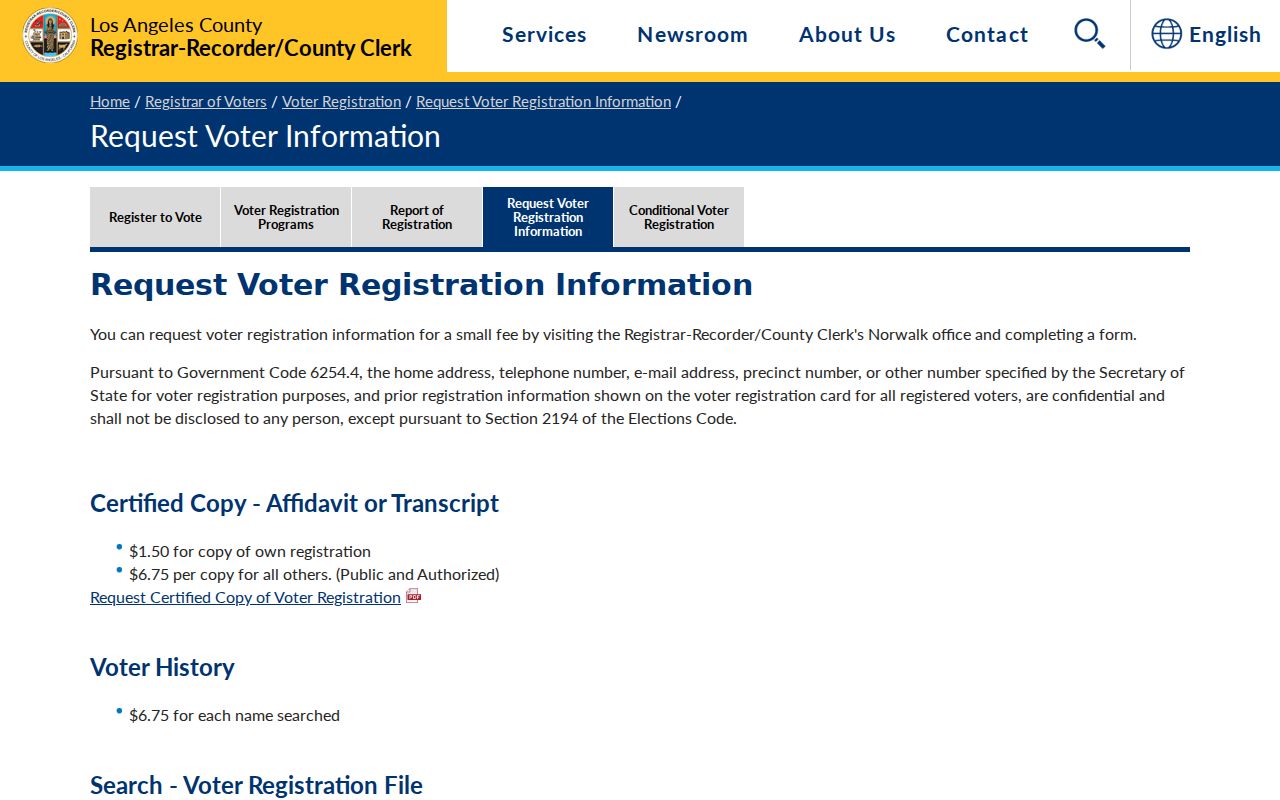
The screen reinforces the key difference between an online self-check and a paid search handled by the Election Information Section.
Request Rosemead Voter File Data
Broader voter data follows a separate state or county process. The California Secretary of State file-request page limits access to persons or groups using the information for election, scholarly, journalistic, political, or governmental purposes, as determined by the Secretary of State. Some confidential registration records are excluded even from an approved release.
The California voter file application asks for applicant identity, any beneficiary or organization, a detailed purpose, the requested file or data, security acknowledgements, and a signed certification. An applicant may seek a full file, a county or file subset, or specific voter information as the form allows. The completed state application goes by mail to the Secretary of State at 1500 11th Street, 5th Floor, Sacramento, CA 95814. The form says emailed and faxed applications are not accepted.
- Choose the state or LA County source based on the scope of the needed data.
- Describe the qualifying purpose and identify any person or organization benefiting from the request.
- Select the file, county subset, or voter data and accept the security duties.
- Sign the certification and mail the state application with its required ID material.
Rosemead Voter Data Fees
LA County maintains channels for larger election data products. The Voter Data Text File page directs requesters to call (800) 815-2666, option 4, to buy election information. It also links a purchase-order form and a voter-data layout, which helps an authorized applicant understand the file structure before ordering.
The county's street-index and vote-by-mail report page separates candidate or committee products from public-political-purpose requests. For the public street or voter index, the listed price is $0.10 per page plus $1.60 handling for each request, and a contract is required. A requester should confirm the current product and total with the RR/CC because a single-name search, a text file, and a page-based index are different services.
Note: The $5 county name search does not purchase the statewide voter file.
Rosemead Voter Data Use Rules
Elections Code §2194 bars personal, private, and commercial uses outside the authorized purposes. California regulations let the Secretary of State or a county elections official, called the source agency, review the stated purpose and reject a request when there is reason to believe the data would be misused. Access is therefore tied to what the applicant will do, not merely to willingness to pay a fee.
An approved recipient must protect the data and stay within the certified purpose. Do not use Rosemead voter records to threaten, stalk, harass, repeatedly contact, or intimidate anyone. California stalking and harassment laws may apply to conduct built from record data, while election law and the signed application create added limits for the file itself.
A sound research record keeps the application, approval, source, release date, and purpose together. That makes it easier to avoid sharing protected fields or reusing a file for a task the source agency did not approve.
Protected Rosemead Voter Addresses
Safe at Home is California's address-confidentiality program for eligible people who fear for their safety. It provides a substitute mailing address and requires state and local agencies to accept that designated address. Related voter protections under Elections Code §§2166, 2166.5, 2166.7, and 2166.8 can keep qualifying registration records confidential.
A missing Rosemead address or record is not proof that a person never registered. The person may be covered by a confidential-voter program, or the requested release may exclude the field. Do not try to defeat those safeguards through another record source. Contact the elections office when a legitimate election or governmental need involves a protected record.
Note: A missing address may reflect a lawful confidentiality program, not an incomplete voter record or a search error.
Historical Rosemead Voter Records
Older poll books and registration indexes can be useful for family history, local civic research, and tracing a person's presence in a past election district. They may survive in Los Angeles County archives, the California State Archives, library microfilm, or special collections. Rosemead incorporated in 1959, so earlier material may be organized under Los Angeles County, the San Gabriel Valley, a precinct, or a nearby community rather than under a modern Rosemead city heading.
No official online source reviewed for the Rosemead research identified a complete city-specific poll-book run. That is a real coverage gap, not evidence that no historical voter material exists. Begin with the approximate year and former address, then ask an archive or library which county election register, precinct book, microfilm set, or finding aid covers that place and date.
Historical access rules can differ from current-file rules, but archivists still may withhold protected personal information. A precise question will work better than asking for every old voter roll associated with Rosemead.